Posts

Showing posts with the label Relative humidity

Influence of Temperature and Relative Humidity on Air Pollution in Addis Ababa, Ethiopia

Image
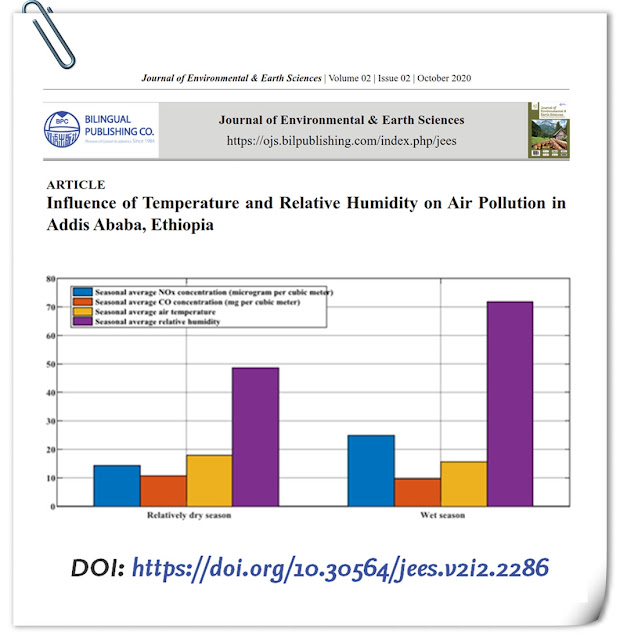
  Mulu Fikeraddis Department of Physics, Worabe University, Worabe, Ethiopia Lake Endeshaw  Department of Physics, Worabe University, Worabe, Ethiopia DOI:  https://doi.org/10.30564/jees.v2i2.2286 Abstract In this paper we access the effects of two atmospheric variables (temperature and relative humidity) on two important pollutants in the atmosphere (Nitrogen oxides (NOx) and carbon monoxide (CO)) by using one year (2016) data of Addis Ababa. Temperature has impact on atmospheric mixing and cause for the reduction of NOx as temperature increases. There are positive correlation between temperature and CO concentration from January to April with (R 2  = 0.69), negative correlation from May to August with (R 2  = 0.92) and no correlation for the remaining months. NOx and CO have moderate positive and negative correlation with relative humidity during the months January-April (R 2  = 0.294 for NOx and R 2  = 0291 for CO) and in the months May-August are R...

Influence of Temperature and Relative Humidity on Air Pollution in Addis Ababa, Ethiopia

Image
Influence of Temperature and Relative Humidity on Air Pollution in Addis Ababa, Ethiopia DOI:  https://doi.org/10.30564/jees.v2i2.2286 Abstract In this paper we access the effects of two atmospheric variables (temperature and relative humidity) on two important pollutants in the atmosphere (Nitrogen oxides (NOx) and carbon monoxide (CO)) by using one year (2016) data of Addis Ababa. Temperature has impact on atmospheric mixing and cause for the reduction of NOx as temperature increases. There are positive correlation between temperature and CO concentration from January to April with (R 2  = 0.69), negative correlation from May to August with (R 2  = 0.92) and no correlation for the remaining months. NOx and CO have moderate positive and negative correlation with relative humidity during the months January-April (R 2  = 0.294 for NOx and R 2  = 0291 for CO) and in the months May-August are R 2  = 0.97 and R 2  = 0.15 for NOx and CO respectively. But th...

Influence of Temperature and Relative Humidity on Air Pollution in Addis Ababa, Ethiopia

Image
Influence of Temperature and Relative Humidity on Air Pollution in Addis Ababa, Ethiopia DOI:  https://doi.org/10.30564/jees.v2i2.2286 Abstract In this paper we access the effects of two atmospheric variables (temperature and relative humidity) on two important pollutants in the atmosphere (Nitrogen oxides (NOx) and carbon monoxide (CO)) by using one year (2016) data of Addis Ababa. Temperature has impact on atmospheric mixing and cause for the reduction of NOx as temperature increases. There are positive correlation between temperature and CO concentration from January to April with (R 2  = 0.69), negative correlation from May to August with (R 2  = 0.92) and no correlation for the remaining months. NOx and CO have moderate positive and negative correlation with relative humidity during the months January-April (R 2  = 0.294 for NOx and R 2  = 0291 for CO) and in the months May-August are R 2  = 0.97 and R 2  = 0.15 for NOx and CO respectively. But th...

Assessment of the Off-season Rainfall of January to February 2020 and Its Socio Economic Implications in Tanzania: A Case Study of the Northern Coast of Tanzania

Image
Assessment of the Off-season Rainfall of January to February 2020 and Its Socio Economic Implications in Tanzania: A Case Study of the Northern Coast of Tanzania DOI:  https://doi.org/10.30564/jasr.v4i2.3135 Abstract This article examines the off season rainfall in northern coast Tanzania (NCT) including Zanzibar which occurred in January and February 2020 (JF). Like the JF rainfalls of 2001, 2004, 2010, 2016 and 2018, the JF (2020) rainfall was more unique in damages including loss of lives, properties and infrastructures. The study used the NCEP/NCAR reanalysis data to examine the cause of uniqueness of JF rainfall in 2001, 2004, 2010, 2016, 2018 and 2020 over NCT and Zanzibar. These datasets include monthly mean u, v wind at 850, 700, 500, and 200 mb; SSTs, mean sea level pressure (MSLP) anomalies, Dipole Mode Index (DMI), and monthly rainfall from NCT and Zanzibar stations. Datasets were processed and calculated into long term, seasonal, and monthly averages, indeed, Precipitat...

Influence of Temperature and Relative Humidity on Air Pollution in Addis Ababa, Ethiopia

Image
Influence of Temperature and Relative Humidity on Air Pollution in Addis Ababa, Ethiopia DOI:  https://doi.org/10.30564/jees.v2i2.2286 Abstract In this paper we access the effects of two atmospheric variables (temperature and relative humidity) on two important pollutants in the atmosphere (Nitrogen oxides (NOx) and carbon monoxide (CO)) by using one year (2016) data of Addis Ababa. Temperature has impact on atmospheric mixing and cause for the reduction of NOx as temperature increases. There are positive correlation between temperature and CO concentration from January to April with (R 2  = 0.69), negative correlation from May to August with (R 2  = 0.92) and no correlation for the remaining months. NOx and CO have moderate positive and negative correlation with relative humidity during the months January-April (R 2  = 0.294 for NOx and R 2  = 0291 for CO) and in the months May-August are R 2  = 0.97 and R 2  = 0.15 for NOx and CO respectively. But th...

Influence of Temperature and Relative Humidity on Air Pollution in Addis Ababa, Ethiopia

Image
Influence of Temperature and Relative Humidity on Air Pollution in Addis Ababa, Ethiopia DOI:  https://doi.org/10.30564/jees.v2i2.2286 Abstract In this paper we access the effects of two atmospheric variables (temperature and relative humidity) on two important pollutants in the atmosphere (Nitrogen oxides (NOx) and carbon monoxide (CO)) by using one year (2016) data of Addis Ababa. Temperature has impact on atmospheric mixing and cause for the reduction of NOx as temperature increases. There are positive correlation between temperature and CO concentration from January to April with (R 2  = 0.69), negative correlation from May to August with (R 2  = 0.92) and no correlation for the remaining months. NOx and CO have moderate positive and negative correlation with relative humidity during the months January-April (R 2  = 0.294 for NOx and R 2  = 0291 for CO) and in the months May-August are R 2  = 0.97 and R 2  = 0.15 for NOx and CO respectively. But th...

Assessment of the Off-season Rainfall of January to February 2020 and Its Socio Economic Implications in Tanzania: A Case Study of the Northern Coast of Tanzania

Image
Assessment of the Off-season Rainfall of January to February 2020 and Its Socio Economic Implications in Tanzania: A Case Study of the Northern Coast of Tanzania DOI:  https://doi.org/10.30564/jasr.v4i2.3135 Abstract This article examines the off season rainfall in northern coast Tanzania (NCT) including Zanzibar which occurred in January and February 2020 (JF). Like the JF rainfalls of 2001, 2004, 2010, 2016 and 2018, the JF (2020) rainfall was more unique in damages including loss of lives, properties and infrastructures. The study used the NCEP/NCAR reanalysis data to examine the cause of uniqueness of JF rainfall in 2001, 2004, 2010, 2016, 2018 and 2020 over NCT and Zanzibar. These datasets include monthly mean u, v wind at 850, 700, 500, and 200 mb; SSTs, mean sea level pressure (MSLP) anomalies, Dipole Mode Index (DMI), and monthly rainfall from NCT and Zanzibar stations. Datasets were processed and calculated into long term, seasonal, and monthly averages, indeed, Precipitat...

Influence of Temperature and Relative Humidity on Air Pollution in Addis Ababa, Ethiopia

Image
Influence of Temperature and Relative Humidity on Air Pollution in Addis Ababa, Ethiopia DOI:  https://doi.org/10.30564/jees.v2i2.2286 Abstract In this paper we access the effects of two atmospheric variables (temperature and relative humidity) on two important pollutants in the atmosphere (Nitrogen oxides (NOx) and carbon monoxide (CO)) by using one year (2016) data of Addis Ababa. Temperature has impact on atmospheric mixing and cause for the reduction of NOx as temperature increases. There are positive correlation between temperature and CO concentration from January to April with (R 2  = 0.69), negative correlation from May to August with (R 2  = 0.92) and no correlation for the remaining months. NOx and CO have moderate positive and negative correlation with relative humidity during the months January-April (R 2  = 0.294 for NOx and R 2  = 0291 for CO) and in the months May-August are R 2  = 0.97 and R 2  = 0.15 for NOx and CO respectively. But th...